
Written by: Dr James Cullingford - Clinical Psychologist and Director of Profound Psychology
Published: March 2026
Updated: October 2026
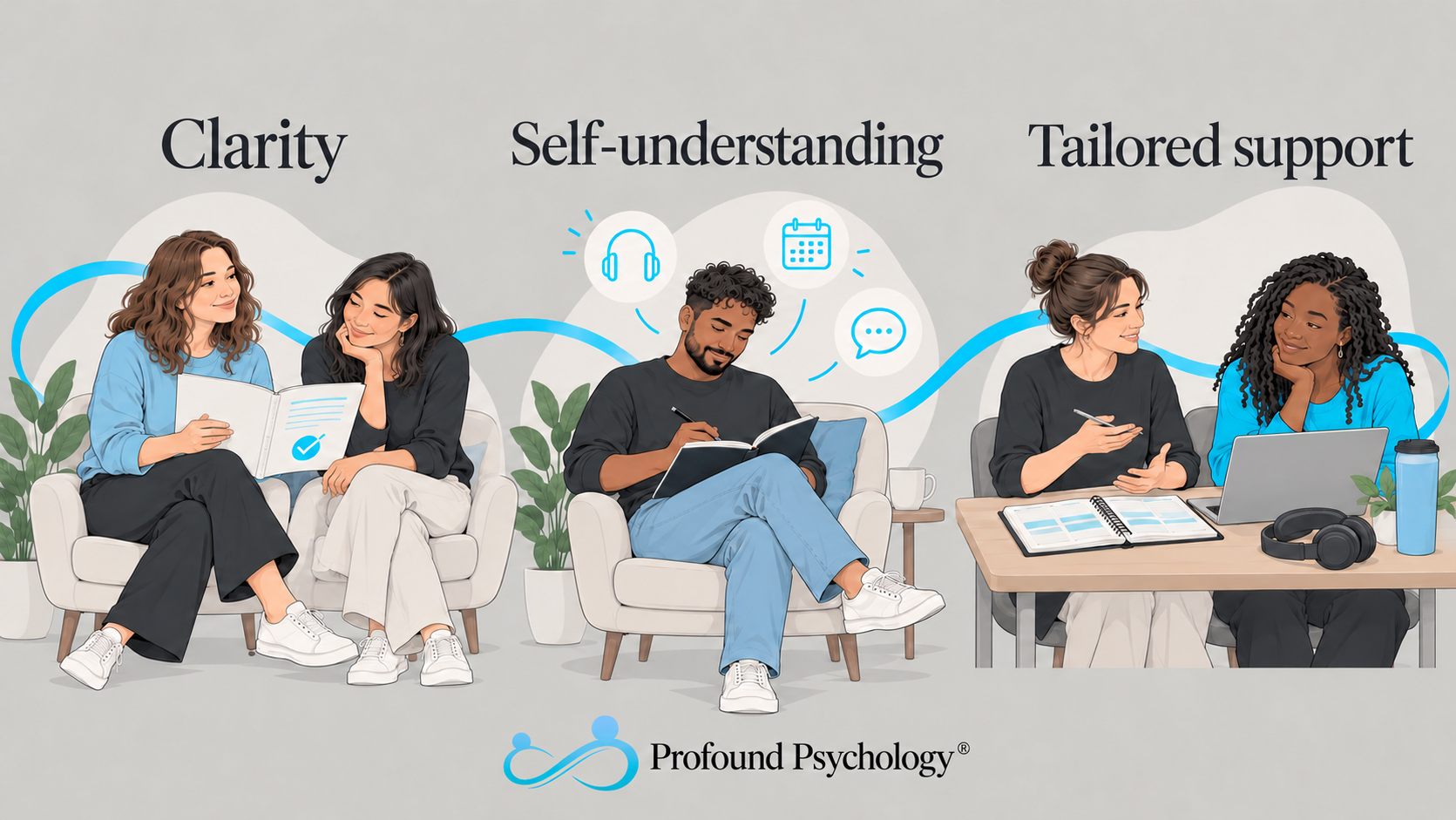
People think about having an assessment for Autism (Autism Spectrum Disorder) and ADHD (Attention Deficit Hyperactivity Disorder) for many different reasons; to access appropriate support or adjustments, to inform treatment or support that they are accessing or seeking out, or simply, they are trying to make sense of their experiences; why they feel different, or experience things in a different way to those around them.
Whether or not a person decides to have an assessment or not is an individual decision, and gaining a diagnosis is not always their ultimate goal.
Why do people seek an Autism or ADHD assessment?
People often come for an assessment after years of wondering why things feel different or find certain things more difficult. These differences can pose challenges in relationships, workplace, education and make certain daily living activities feel hard. You might relate to:
Feeling overwhelmed by sensory environments
Struggling with attention, organisation, or time management
Finding social situations confusing or exhausting
Experiencing burnout or chronic stress
A sense that you’ve been “masking” or coping for a long time
A neurodiversity assessment can help make sense of these experiences in a compassionate and structured way.
The benefits of getting a diagnosis
1. Greater self-understanding
One of the most significant benefits of an Autism or ADHD diagnosis is finally having an explanation for your experiences. Many people describe this as a sense of relief — understanding that their differences are not personal failings, but part of how their brain works.
2. Understanding your strengths and needs
Understanding how your brain works can help you find ways to work with your brain, not against it. Going through the assessment process will help you to identify things that you are finding challenging, explain why this is difficult for you, and think of ways to support your needs. Whilst it is important to highlight your needs, a part of the assessment process should focus on your areas of strength; what works well for you, and what skills you have and how you might be able to use these to your advantage.
3. Access to appropriate support and adjustments
A formal diagnosis of Autism or ADHD does not automatically entitle you to increased support or benefits. It can, however, based on your own specific individual needs, help you access:
Reasonable adjustments in the workplace, education and across public services under the Equality Act (2010).
Support in seeking appropriate employment (e.g., Disability Employment Advisors at Job Centre Plus; seeking work with companies who have joined the ‘disability confident scheme’).
Understanding and support from your family and friends.
Specialist services or therapies, dependent on services available in your area.
Social care assessments - whilst anybody can access an assessment with Adult Social Care, having a better understanding of your needs may help to inform the support you need.
4. More appropriate mental health support
Undiagnosed neurodivergence is often linked to:
Anxiety
Depression
Burnout
Low self-esteem
With a clear diagnosis, therapies and psychological support can help make sense of your experiences as neurodivergent, and how this impacts your thoughts, feelings and behaviours. Common themes of therapy might include self-criticism, self-acceptance, emotion regulation and addressing trauma.
Having a clearer understanding of your own strengths and needs can mean therapy can be adapted to suit you. A neurodiversity-affirming approach ensures that support works with your brain, not against it, and should promote your strengths, empowerment, autonomy and communication (in a way that works for you!).
5. Understanding challenges with relationships and communication
People who are autistic, or have ADHD often communicate in different ways to neurotypical people. This doesn’t mean that an autistic/ADHD person’s way of communicating is ‘wrong’, or something that needs ‘fixing’. However, differences in communication styles often lead to misunderstandings and a break-down in communication.
Gaining a better understanding of your individual communication style can help to identify patterns of communication breakdown which may be impacting relationships in different areas of your life (e.g., partners, family members, friends, colleagues).
By promoting communication needs, and sharing these with those around you, it can help others understand how best to support you, and hopefully create a more inclusive and supportive culture.
6. Validation and reduced self-blame
Being an autistic person, or person with ADHD, in a predominantly neurotypical environment can be a scary and confusing experience for many neurodivergent people. It might be hard to make sense of how other people act, how they behave, and why people might not be experiencing things how they are experiencing it. A common experience of neurodivergent people is repeatedly being told they are doing things “wrong”, “acting out”, or being punished for the way they act.
This can lead to years feeling “different” or “not good enough”, and feeling “this is my fault”. A diagnosis can help you to understand why you may act, communicate or experience things in a different way. For many people, this provides validation and helps reframe those experiences with compassion and understanding.
Is getting an autism or ADHD diagnosis always beneficial?
A diagnosis is a personal choice. Some people find self-identification helpful, while others benefit from the clarity and practical support that a formal diagnosis provides.
If you are considering an Autism or ADHD assessment, it can be helpful to think about what you hope to gain — whether that’s understanding, support, or access to services.
It is also important to consider some potential challenges with a diagnosis:
1) Career - some careers will require you to disclose your medical records. Whilst this does not always prevent you from a career pathway, there may be further assessment which could lead to exclusion. An example of this is the Armed Forces.
2) Stigma - whilst there is ongoing work to promote education and support amongst the neurodivergent community, some people do still have fixed or out-dated views on what autism or ADHD is, and there is the potential for discrimination.
3) Time and energy - assessments can sometimes feel uncomfortable when having to talk about your personal experiences, some people can find this stressful and tiring.
4) Diagnosis does not automatically increase support.
5) Emotional impact - after receiving a diagnosis, it is common to experience lots of different emotions (e.g., anger, guilt, shame), this can be a difficult experience for some.
What happens during a neurodiversity assessment?
A neurodiversity assessment is a structured process used to understand how your brain works, particularly in relation to Autism (Autism Spectrum Disorder) and ADHD (Attention Deficit Hyperactivity Disorder). These assessments are carried out by qualified clinicians and are based on recognised diagnostic criteria.
An Autism or ADHD assessment typically includes:
A detailed clinical interview.
Exploration of developmental history (including childhood).
Standardised assessment tools.
Questionnaires or rating scales.
A comprehensive diagnostic report.
Considering an assessment?
At our Lincoln-based clinic, assessments are carried out in a calm, neurodiversity-friendly environment, with adjustments made to suit individual needs.
At Profound Psychology’s clinic in Lincoln, we offer:
Combined Autism and ADHD assessments
Neurodiversity-affirming therapy
We aim to provide a calm, accessible, and supportive environment, with reasonable adjustments tailored to each individual.
Taking the next step
If you’re wondering whether an Autism or ADHD assessment might be right for you, you’re not alone. Seeking answers is a positive and empowering step.
You’re welcome to get in touch to discuss your needs or book an initial consultation.